
Moles / Flat Warts / Seborrheic Keratosis / Skin Tags, etc.Agnes Treatment for Sebaceous Hyperplasia and Syringoma

Agnes Treatment for Sebaceous Hyperplasia and Syringoma
Agnes + Er:YAG Combination Treatment (CO2 added when needed) *VAT not included
Options
Treatment Details






Our Approach to Reducing Sebaceous Hyperplasia Recurrence
“If you only remove the surface, the core remains.”
Sebaceous hyperplasia is a lesion caused by the excessive enlargement and proliferation of sebaceous glands within the dermis.
However, many treatments merely involve superficially shaving off the visible lesions with a laser.
While such methods may seem temporarily effective,
if the sebaceous glands remain, they may proliferate again and lead to recurrence.
Kkeut Clinic approaches it differently.
Surface removal + Management of the underlying cause = Aims to reduce recurrence.
We go beyond improving visible symptoms;
we aim to address both the cause and symptoms for potentially more effective results.
To achieve this, we combine the use of two devices.
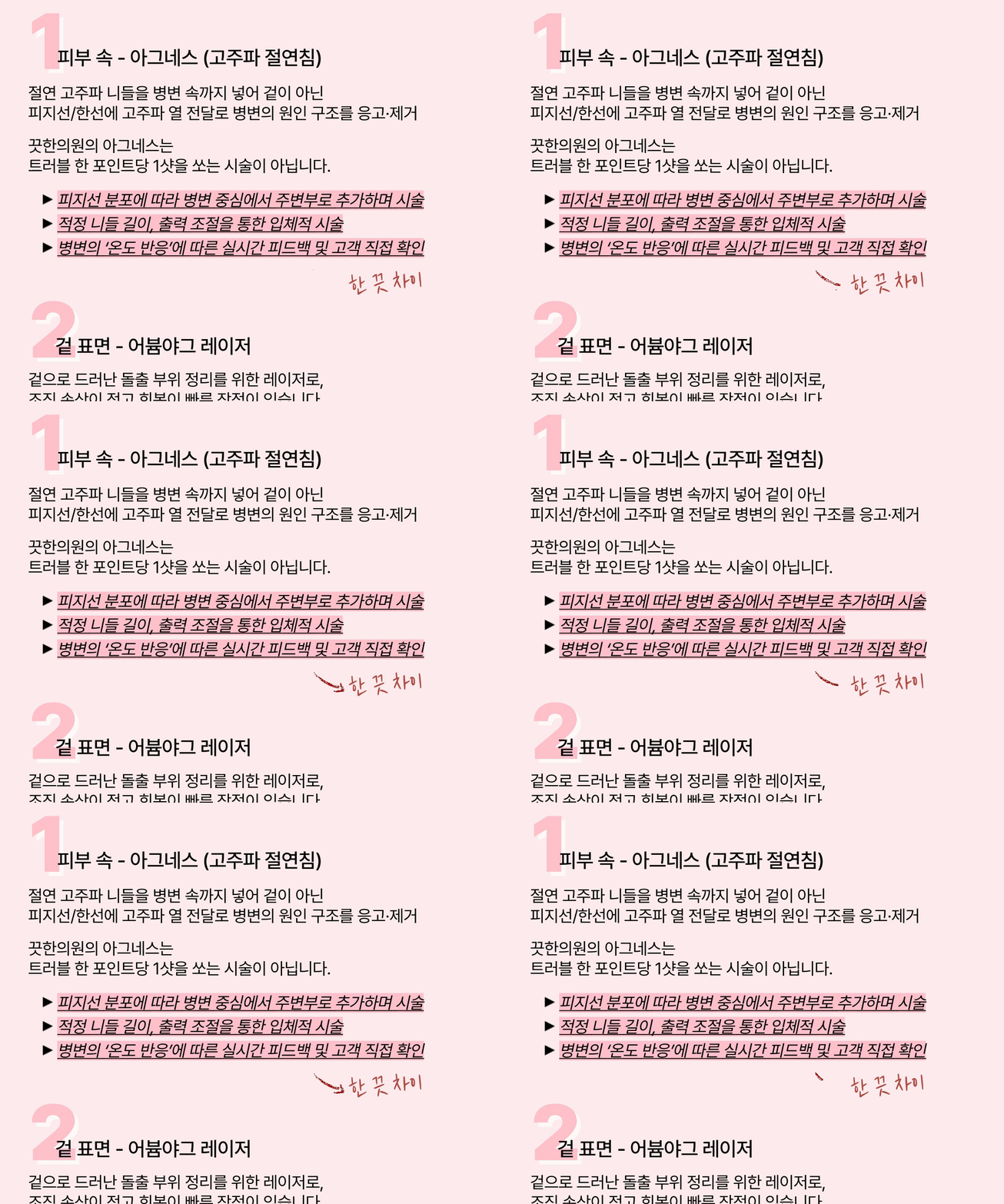
1. Secret Agnes RF (Insulated RF 1-pin Needle)
It directly delivers high-frequency heat to the location of the sebaceous gland,
selectively destroying the sebaceous gland.
By using an insulated needle, it aims to minimize damage to the epidermis or surrounding tissues,
precisely targeting only the sebaceous gland.
This is one important approach to addressing the underlying cause of sebaceous hyperplasia.
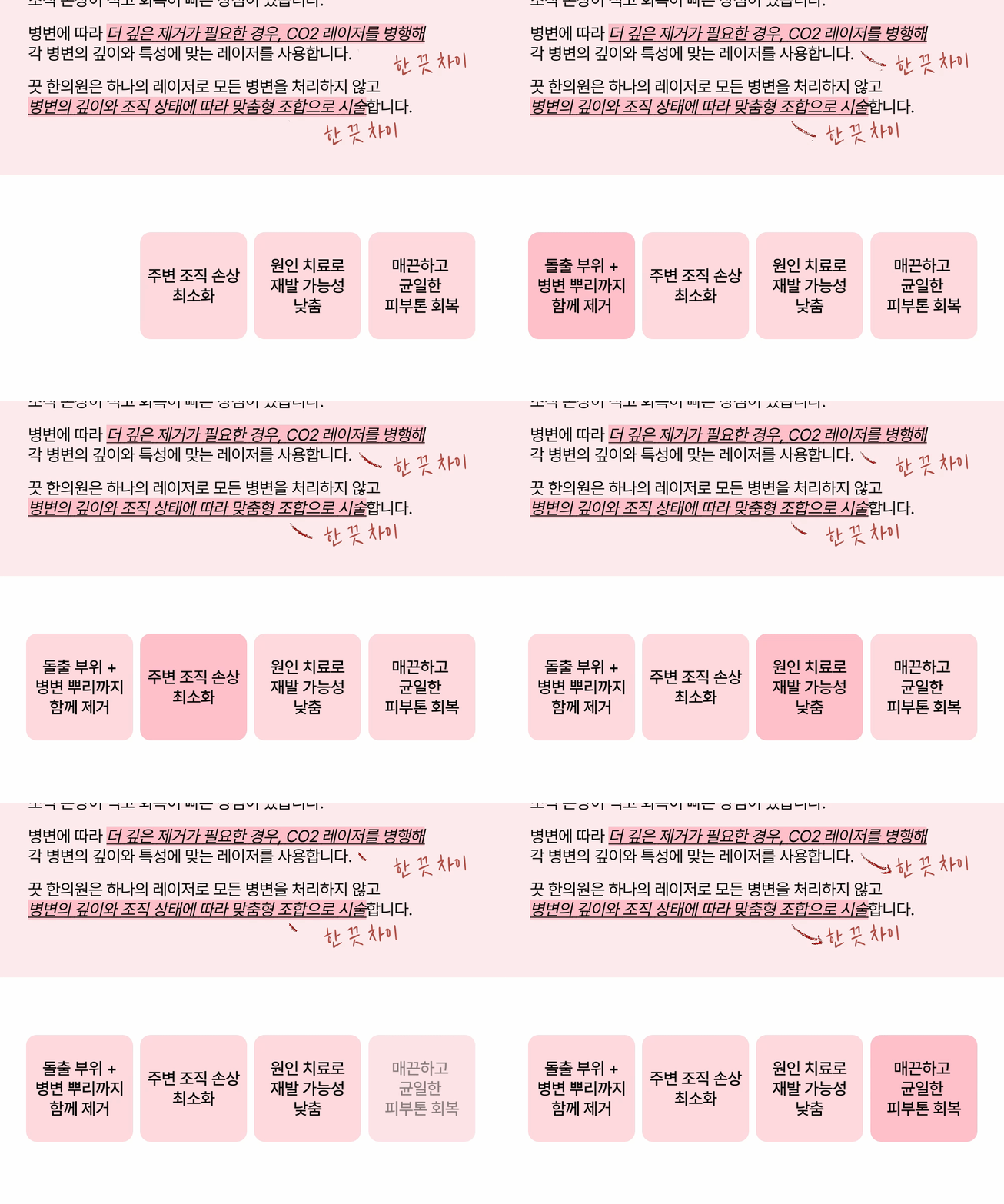
2. Erbium-YAG Laser (Er:YAG)
It allows for precise depth of ablation,
delicately removing protruding lesions.
Reducing tissue damage may help ease recovery and reduce the likelihood of scarring.
If necessary, CO2 can be used in conjunction to remove even deeper lesions.
Different from simple removal procedures
CO2 stand-alone ablation → The surface may be removed while sebaceous glands remain → Recurrence may occur
Kkeut Clinic combination treatment → Sebaceous gland itself destroyed + Surface lesions cleared → May help reduce concerns about recurrence
Characteristics of Sebaceous Hyperplasia
Sebaceous Hyperplasia
Simple removal alone may not provide satisfactory results.
Treating both the surface and the underlying cause may be more effective in reducing the possibility of recurrence.
Do you see these symptoms?
Small, round bumps on the forehead, cheeks, or around the nose
Umbilicated shape with a central indentation
May look like acne or a pimple, but no contents come out when squeezed
Persists for a long time or gradually increases in number
These may not be just simple blemishes,
but may be Sebaceous Hyperplasia, a condition where sebaceous glands are overproliferated.
Treatment Steps
See each step, from your first consultation to completion.
- 01
Step 1. Cleansing
- 02
Step 2. Detailed consultation with the clinician
- 03
Step 3. Apply topical anesthetic cream
- 04
Step 4. Treat the affected area
Treatment Basics
Treatment time, anesthesia, recovery and how long results last, at a glance.
TIME
Varies with the number and size of lesions
ANESTHESIA
Anesthetic cream (15–30 min)
RECOVERY
Avoid washing the treated area on the same day if possible. Keep regenerative tape or gel on the area for 2 weeks.
DURATION
Permanent removal; recurrence may occur depending on the lesion
Ideal For
One Fine Difference makes real results.
- KKEUT POINT 01
Those who want to keep their skin clearer
- KKEUT POINT 02
Those whose skin feels uneven because of small raised lesions on its surface
Q&A
Answers to the questions we hear most.
Do I really need to combine it with Agnes?

Combining Agnes treatment to address the sebaceous and sweat gland tissues related to the lesions may help reduce the possibility of recurrence.
Is there any downtime?
You need to apply regenerative tape (DuoDERM, DuoDERM gel, etc.) for at least 2 weeks.
Will it hurt a lot?
While pain varies from client to client, we apply anesthetic cream to help with the procedure.
Cautions
Results = Treatment × Aftercare. Please follow the notes below.
For the first week after treatment, it is advisable to avoid alcohol, smoking, saunas and strenuous exercise.
Minimize UV exposure to help prevent pigmentation in the treated area, and apply sunscreen regularly when going outdoors.
It is recommended not to wash the treated area on the day of treatment.